
Good news, crit seekers.
Today we have a very special entry, an interview with Volomir, brand new champion of the last Warhammer Underworlds Grand Clash that took place in the Warhammer World a week ago. In this interview he will tell us how he won and will explain the crazy strategy of using 15 objectives that has everyone speechless. Are you going to miss it?
A few days ago an event took place, one of those that does not happen often enough. A Warhammer Underworlds Grand Clash was played in the Warhammer World with no more (and no less) than 124 participants. Experienced voices say that it was the largest tournament in the history of Warhammer Underworlds!
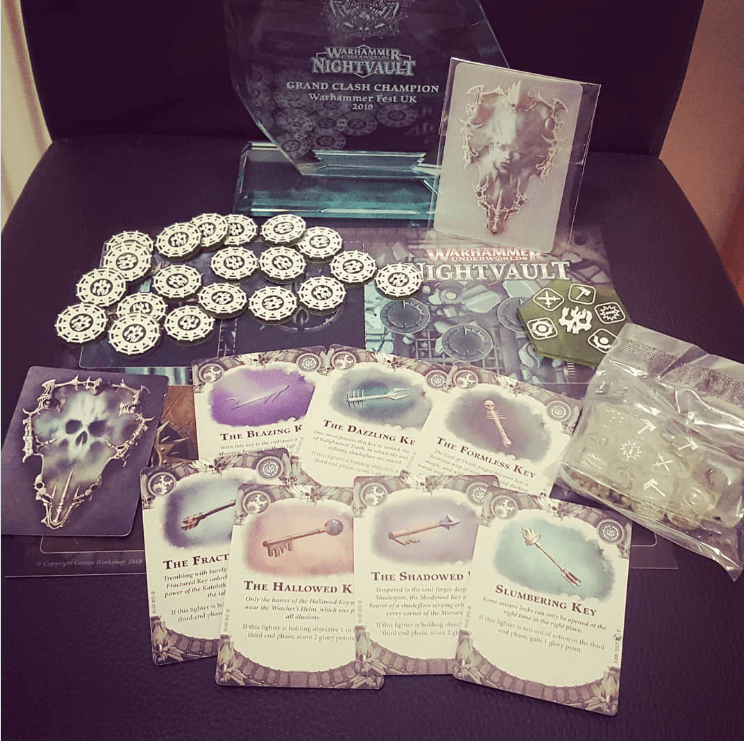
For us the best of all is that the tournament was won by a Spanish player (from the seven people Spanish army, we will tell you about it in a future post). The great Volomir rose to infinite glory using the Grymwatch. Let’s first look at the loot he took home.

Since he is such a good person, he has given us some of his valuable time in this interview where he will tell us how he used this innovative strategy to leave all his rivals behind. He will also tell us about other aspects that relate to the Warhammer hobby. Long but very interesting reading, the kind you can use to visit the toilet and enjoy. Here we go!
1. How and when did you start in the world of Warhammer?
I started with Warhammer Fantasy back in 1997, introduced by a school friend who had just discovered it. Soon I got my parents to buy me a multi-component Chaos Warrior regiment that had just been released. The hobby conquered me and I fell deeply in love with Warhammer ever since. At first I only liked Fantasy, but then I also fell for 40k, and in 2006 I got fully into the world of painting for exhibition, becoming a regular contestant in Golden Demon.
2. You have been playing Warhammer Underworlds since Shadespire with considerable success, what are the fundamental pillars of your game?
Warhammer Underworlds is an absolute marvel. When it came out I realized they had created the perfect game for me. I love strategy games, boardgames, card games and miniature games. Underworlds has all this and more! It allows me to prepare a warband with some of the best designs ever made in Warhammer, paint it to the highest level, play with it, and also participate in Golden Demon. With this, my approach to the hobby comes from the 3 fronts: painting, collecting and playing.
If we stick exclusively to the game, for me the fundamental thing in Underworlds is to find a strategy that allows you to score and at the same time prevent the enemy from scoring, or at least look for a mechanism to ensure that you score more than the opponent, minimizing the risk of having your strategy blocked or depending too much on the dice. I’m not a crazy aggro player, I don’t like to gamble on getting lucky at the dice. That’s why I tend to go for a tactical game of board control, treasure control or feature tokens, and passive scoring strategies. I love strange mechanics that allow you to do different things, like hordes that resurrect, extra-drawing decks, or warbands that have a lot of ability to reposition themselves when needed.
3. The Warhammer World is a special place, no doubt, and succeeding on this stage, in a tournament of 124 people from all countries, must be very exciting… What have been the keys to being prepared and being able to succeed in these conditions?
It’s Warhammer’s mecca! Between Underworlds tournaments and Golden Demon contests, I always find some excuse to visit at least once a year. A Grand Clash like this with so much participation makes it the most special event in Underworlds. It is very exciting to walk the path from the moment you decide to participate until the day the tournament arrives. (editor’s note: he is telling the truth, he has been to a few Grand Clashes and already won one in 2019)
Nemesis is a very interesting format that combines deck building with the possibility of thoroughly preparing yourself against what an opponent can bring to the table. My preparation consisted of testing a few warbands that play with similar strategies, testing different combinations in local tournaments, and above all, learning all the objective cards in the available decks. For me, objectives are the key to the game, and knowing well the options your opponent has to score you is what makes the difference when it comes to preventing their glory points. This is something very affordable to do in Nemesis today.
4. Your deck consists of 15 objectives! This has left a lot of people wondering. Can you explain this decision and the key points to make the deck work so well?
Editor’s note: We first show Volomir’s deck, titled Volomir’s Grym15

I did a study of how many glory points any deck can really score and looked for ways to maximize my options. The new edition has standardized the design tremendously, so that all warbands give 7 glory points when annihilated, and all Rivals decks add 16 glory points in objectives. In Nemesis you can mix two Rivals decks, but you can only bring a maximum of 6 immediate objectives, and all of these immediate objectives give 1 glory point at the moment. Therefore, the maximum glory you can carry in your objectives is 6 immediate points, and 20 end-of-phase points (if you take the 12 objectives of the two decks). But of course, you can’t score all of those objectives, since there are only 3 windows to score end of phases, and in each of them you can only score 3 objectives. This implies that you can score a maximum of 9 of those 12 objectives. If the 3 objectives that we remove in each combination are the ones that score the least, we have a total of 23 points left (6 in immediate, and 17 in end-of-phase). This leaves a glory ceiling in any game of 30 points (23 in objectives and 7 in kills).
I then sought to get as close as possible to this ceiling. I tried adding objectives in decks with a lot of synergy between them that fit what I like to play. There were mainly 3: Pillage&Plunder, Countdown to Cataclysm and Wrack&Ruin. I saw that the strongest combination was P&P and CtC, and I tried 14 objectives first. In the days before the Grand Clash I thought I could go further and play all 15, getting closer to that ceiling of 23 points. I stayed at 22 simply because I saw that risks were reduced by changing an objective of 2 glories for another of 1 that was more feasible to score.
For me, the key to success with 15 objectives during the game is to make sure you score the immediate objectives as soon as possible in the phase so that you have 3 end-of-phase objectives with enough time to be able to complete them solidly at the end of the round. If you score all 3, fantastic: everything is going smoothly. If you don’t, it’s not a drama either. You discard those and draw 3 again. This is very valuable to me because it saves me from having to think about whether or not I keep an objective from one round to the next, and it saves me time, which is very important in a tournament. Those who know me well know that playing fast is not one of my strengths! Having so many objectives means that you don’t run out of a deck at the end of the game and you have plenty of points to never fall short. Along the way, in addition to securing the phase endings, you try to score the maximum points by killing enemy fighters.
In the case of Grymwatch, the 15 objective strategy is even more interesting. Since there are statistically fewer immediate objectives at the beginning, it is very likely that you will be forced to go behind in the game, which makes you the Underdog. This is very valuable for the Grimwatch because not only do they resurrect but they also do so inspired, it also allows you to easily score Claim the Prize, and take advantage of better abilities from the power deck.
On the other hand, it is a strategy that has significant risks. The end of phase scoring windows are extraordinarily tight. Reaching the end of the phase with an immediate objective in your hand breaks your rhythm, and you also have the risk of being left with immediate objectives at the bottom of the deck, which you may not see throughout the game. It is certainly not a strategy that everyone will like.
To mitigate this risk, the entire game is played always with the thought of scoring those end-of-phase objectives, regardless of the round. Even if you have a surge objective, you have to play so that with whatever hand you have, you can always score any of the end-of-phase objectives that come. Fortunately, there is a lot of synergy between them. Let’s see these cards in detail:
- Against the Odds (1) – Very easy, but remember to be on a feature token with an odd treasure to be able to score it, so it doesn’t catch you off guard.
- Lost in the Depths (1) – Another one that depends entirely on you, and is very easy to score, you simply have to be careful to prioritize having your fighters always separated. Get used to doing it every time and it will score itself without thinking.
- Desolate Homeland (1) – A gift. If you place only one feature token on your territory, you score it for sure. If there are two, simply try to control them as much as possible to ensure that at least one of them is on the cover side.
- Spread Havoc (1/2) – Another treat. You don’t even have to think. You always score it, whether it’s one or two points. Enjoy.
- Wreckers (2) – Another one that if you always think of scoring it, when you draw you will score it. Always have 2 or 3 wounded/dead rivals, whether you have the objective in hand or not. Raise the cataclysm to 2 as soon as you can, but not beyond that if you see that scoring this objective is going to cost you (normally it doesn’t cost much, but just in case, keep that in mind). Once you’ve scored it, raise Cataclysm as much as you can to take advantage of its benefits with power cards.
- Broken Prospects (2) – Forces you to delve on 3 treasures, or delve on one that was occupied by an opponent at the beginning of the round. In the first round you will only do this if you get on 3 treasures and delve. Depending on the time of the game it can be difficult to do. In the first one it forces you to place yourself on three treasures which will typically take you 3 turns or spend a power card. In later rounds it is very key not to forget that you can score by delving a treasure previously occupied by an opponent, so do not forget how the board at the beginning of each round and mention it to your rival so that there are no arguments later.
- Set Explosives (2) – Combines with several objective cards from the deck, the point is always to be on top of enough feature tokens that allow you to score it. If you always prepare to score this one, you are also preparing for the last two ones that are the icing on the cake.
- Torn Landscape (2), Strip the Realm (3) – Like I say, these are the cherry on top. If you manage to score them, you have almost certainly won the game. If not, you have the rest of the deck left to score so don’t stress if you have to throw them away because you couldn’t score them.
Additional considerations:
- Placing feature tokens next to the edge allows you to always put your opponent in check when they get on them. The Grimwatch returns on any edge, and Gristelwel is ruthless when this happens.
- Placing feature tokens adjacent to the stagger hexes allows you to use Violent Blast to push your people on them or push away your opponent out of them.
- Your leader is key, and your opponent will try to kill him as soon as possible. While he tries, you get on as many feature tokens as you can. Hopefully he won’t be able to kill him and you will have won the game.
- It’s usually a good idea to gear up any ghouls you’ve revived. It will make them stronger but your opponent will not want to kill them because they will not give glory points. There’s nothing better than watching your opponent lose actions by killing things they don’t score for.
- Attack is the best defense. Prioritize maximizing the number of attacks that allow you to deal damage while getting on top of those feature tokens.
- The warscroll allows you a different ability per turn than the 3 that the Grymwatch has. Choose well what you are going to need every round. I usually start with the defense re-roll in the first round because you have the entire Guard at home, but then depending on how the game goes, you will be interested in the +1 attack or the double «In the Name of the King». I typically go for the double «In the Name of the King» in the second round to take advantage of the leader as much as I can before he dies (because he probably won’t make it to the last round alive), and secure the turning around of the game in the third round by attacking everything I damaged in previous rounds.
Apart from these instructions, as I said before, it is important to play to deny the opponent’s objectives. But of course, this is not specific to this build: it should be the default tactic in any game.
5. Of all the rivals or games you played during the tournament, which one do you prefer? Was there any extreme situation?
I would pick the game against Stefan Varga, who played Zarbag’s Gitz. It was probably the matchup that I was most scared about (because I think Zarbag is the most powerful and versatile warband right now), and he played it brilliantly. He boldly raided on his first turn right into the heart of my gang with the fanatic, but I got lucky and was able to save my leader. Then luck continued on my side when using Cataclysm’s pinning cards I managed to kill two of his fighters and not harm any of mine. From then on the game was completely on my side but I knew that without that stroke of luck, I would have had to sweat a lot to win.
6. Were you afraid of any specific gang or confrontation during the tournament?
Yes. As I said before, Zarbag was the warband that I feared the most. They can play the same thing as this warband and do it better, and not only that but they have options to play in many other ways. It is the warband to fear in the current meta. Then there’s also Zondara, who are a pain in the ass because of how much they can draw and bring back. Lastly, I was very surprised by how well Ylthari play, which may be one of the warbands I try out soon.
7. After the tournament, would you change anything about the deck?
I would only change Commanding Stride for Wary Delver. Commanding Stride was intended to get the leader to safety, but really any warband with enough mobility is going to get to your leader anyway, while Wary Delver allows you to try to save the leader, but additionally allows you to use it to get other warriors to safety.
Another option is to put Uneven Contest to reach the ceiling of 23 glory points and remove Lost in the Depths, which gives one less point and is the end of the phase that can restrict your playing options the most. I suspect it will be like hitting Nirvana for this strategy!
8. Of everything it means to win the tournament, what are you most excited about?
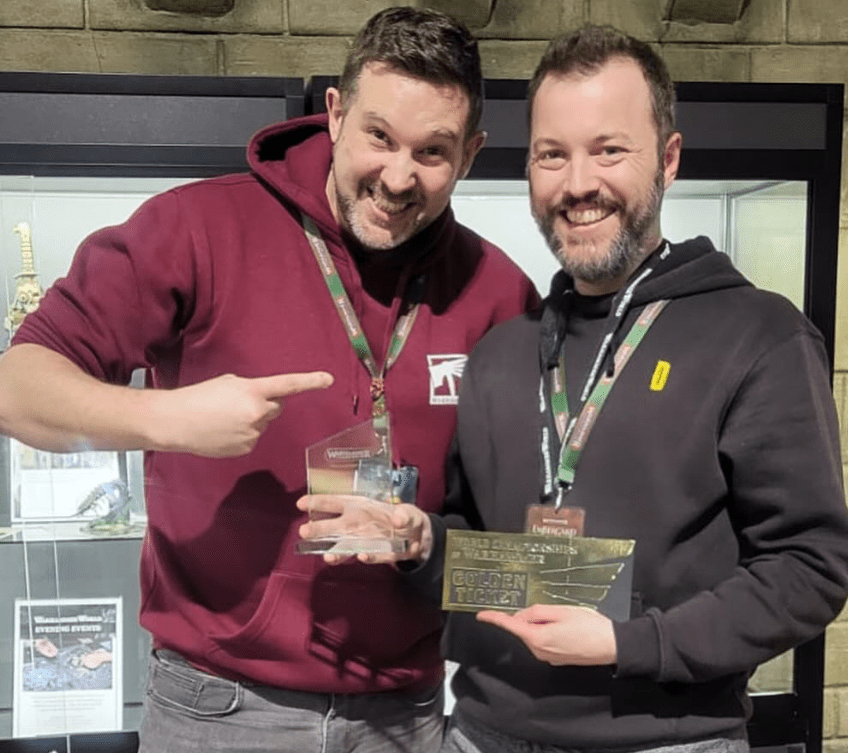
Without a doubt, what I am most excited about is having the opportunity to represent Spain in the World Championships of Warhammer (editor’s note: I can’t think of anyone better than you to represent Spain!). I tried to get a ticket for the last two World Championships with no luck.
9. Talking about the past, future and present of Warhammer Underworlds. Did you personally like the edition change? What have we gained and lost?
It seems like a very good change to me. I think the game has gained much more than it has lost. We have lost a lot of depth and complexity because they have simplified many rules, but for me this has turned out to be very positive. The game is still essentially just as strategic and competitive, with a much lower entry point. It is very easy to learn and with a line of new releases that does not force you to buy everything that comes out to maintain the competitive-edge. In fact, in this Grand Clash I have only used the decks that come in the Embergard starter box.
Whenever people ask me about Underworlds I say it’s at its best, but it’s true! (editor’s note: you got really close to Nick!)
10. In addition to playing Underworlds, you are quite known for being an excellent painter. Remind us of your great achievements as a painter. What do you like more, painting or playing?
I always say that I identify myself more as a painter than as a player. I’m a fan of Golden Demon (I have 14 of them) and it’s what I like most about the hobby. Some will remember pieces like the diorama of «The Last Stand of the Crimson Fists» based on the iconic illustration of the same name by Dave Ghallager, or my High Elves projects that I spent several years presenting to Golden Demon. In recent times I have presented 3 pieces set in Warhammer Underworlds: first a converted Stormsire’s Cursebreakers that I am very proud of (I won my first Grand Clash with this warband), then a diorama in which Celestus fights against Drepur creating a Banishment Area (based on the faction card they had) and then a composition with Hedkrakka’s Madmob. I love the game but these painting projects are what really fulfill me. (Editor’s note: here is his spectacular instagram)

11. Write some last words or dedicate your win if you want.
I would like to take the opportunity to call the entire Underworlds community, to take advantage of the great momentum we have in this new edition and get more new people on board. What makes a game great is its community and we are doing very good things, especially now in Spain. I am very excited to have the opportunity to represent it in the next World Championships! I think we have some of the best players at the moment and we can do great.
I also want to thank my friends from «Los Cobras» for the great trip we enjoyed and I hope to be able to repeat soon, hopefully we will be able to bring more Spanish representatives to the World Championships!

Well, I hope you really liked the interview, there are undoubtedly many lessons to be learned from it. Congratulations again and infinite thanks to Volomir for his time. See you around!
All the best.
PincelFalso
![Avatar de [Entrevista] Volomir, Ganador del Grand Clash Feb 25 en WHW – Crítico y Culo: Blog Warhammer Underworlds](https://criticoyculo.com/wp-content/uploads/2023/11/cropped-titulo-cuadrado-1.png?w=40)


 Crítico y Culo: Blog Warhammer Underworlds
Replica a [Entrevista] Volomir, Ganador del Grand Clash Feb 25 en WHW – Crítico y Culo: Blog Warhammer Underworlds Cancelar la respuesta